



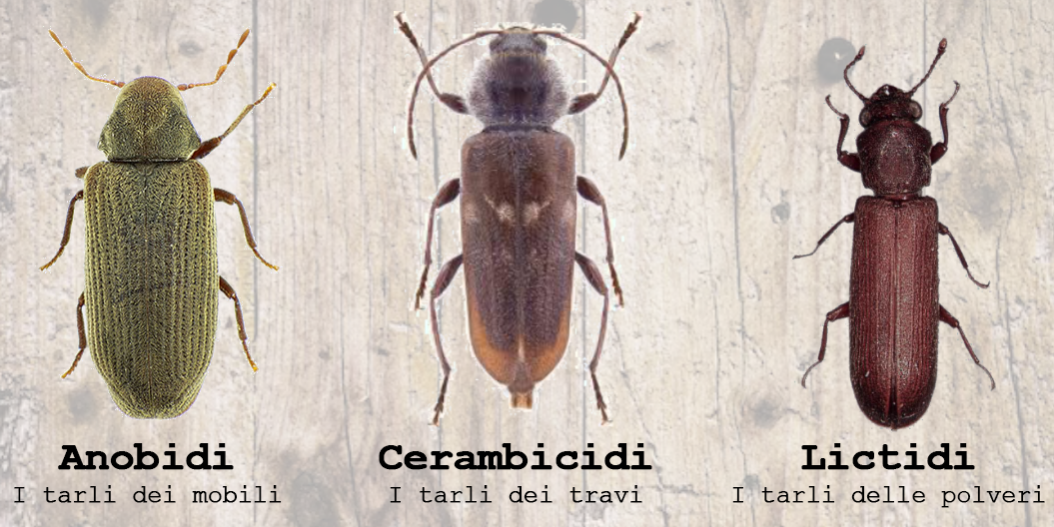
Woodworms do not refer to a single species, but rather to a group of wood-boring beetles that feed on wood during the larval stage. The most common domestic infestations are caused by three main families: Anobiidae, Cerambycidae, and Lyctidae.
Knowing the differences between these families is essential for correctly identifying the problem and choosing the most effective treatment.
1. Anobiidae – Furniture Woodworms
Anobiidae are the most common woodworms in homes. The most widespread species include Anobium punctatum (common furniture beetle) and Xestobium rufovillosum, also known as the “death watch beetle.”
Main Characteristics
- Prefer softwoods (spruce, pine, poplar)
- Attack furniture, window frames, beams, and flooring
- Small, round exit holes (1–2 mm)
- Very fine powder, resembling talcum
Biological Cycle
The larval stage can last from 2 to 5 years. During this time, larvae bore internal galleries, feeding on cellulose. Adults live only a few weeks, solely for reproduction.
In the case of Xestobium rufovillosum, a characteristic ticking sound produced by the male can be heard, used to attract the female.
2. Cerambycidae – Structural Woodworms
Cerambycidae are one of the most dangerous families in terms of structural damage. The best-known species is Hylotrupes bajulus, known as the house longhorn beetle.
Main Characteristics
- Affects structural timber (beams, floors, roofs)
- Prefers aged resinous woods
- Oval or elliptical exit holes (4–8 mm)
- Granular frass with visible wood fibers
Structural Risks
Larvae dig deep and wide galleries that can reduce the mechanical strength of load-bearing structures. Untreated infestations can compromise the stability of the building.
The larval stage can last 5–10 years, with progressive damage often invisible from the outside.
3. Lyctidae – Powder Woodworms
Lyctidae primarily attack hardwoods rich in starch. The most common species is Lyctus brunneus.
Main Characteristics
- Prefer oak, walnut, mahogany, and ash
- Small exit holes (1–2 mm)
- Produce abundant, very fine powder
- Often attack parquet and modern furniture
Biological Peculiarities
Females lay eggs in the wood pores. Larvae feed on the starch present in the sapwood, gradually turning the interior of the wood into fine powder.
Main Differences Between Families
| Family | Type of Wood | Exit Holes | Frass | Structural Risk |
|---|---|---|---|---|
| Anobiidae | Softwoods | 1–2 mm, round | Fine, talcum-like | Medium |
| Cerambycidae | Structural timber | 4–8 mm, oval | Granular | High |
| Lyctidae | Hardwoods | 1–2 mm | Very fine powder | Medium |
Conclusion
Correctly identifying the woodworm family is essential for selecting the most appropriate treatment. The type of wood affected, the size of the exit holes, and the consistency of the frass are key indicators for an accurate diagnosis.